9 min read
Gopher and Gemini: The Internet We Left Behind
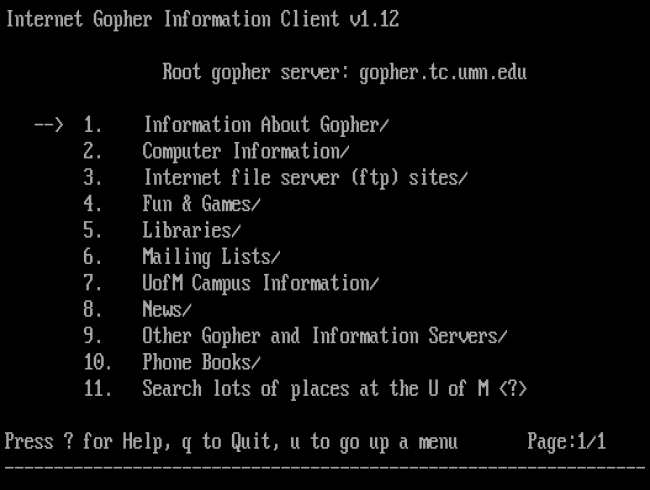
I’ve been spending time lately exploring something called Gopher — a text-based way of browsing the internet that existed before the web as we know it. It launched in 1991, and for a brief window, it was actually the main way people found and read information online.
What is Gopher?
Gopher came out of the University of Minnesota in 1991. Think of it like a table of contents for the internet — you click through a series of menus to find documents, files, and links to other servers. No fancy design, no images mixed in with the text, no ads or pop-ups. Just folders and files.
It’s bare-bones by today’s standards, but that simplicity was the point. Gopher gave you a clean, organized way to find and read things online before web browsers could do much more than display text.
How the Web Won
By 1992, Gopher had serious traction, especially at universities. But three things converged to kill it off.
1. The Licensing Mistake
In February 1993, the University of Minnesota announced it would start charging businesses to use Gopher. The fee was small, but the message was clear: this isn’t free anymore. Two months later, CERN (the research lab that invented the World Wide Web) released it for anyone to use — completely free, no strings attached.
That contrast made the choice obvious for anyone building something new.
2. Inline Media
Gopher treated images as separate downloads. You’d click a link, download a file, and open it in a separate program to view it. The web changed that — images could appear right on the page, mixed in with the text. When a browser called Mosaic came out with this feature, the web suddenly felt alive in a way Gopher couldn’t match.
- Gopher: Navigate menu → click link → download file → open in viewer
- Web: Open page → everything is right there
3. Layout Flexibility
Gopher locked you into a strict folder-and-menu structure. That made it clean, but also rigid — there was no way to design a page the way you wanted it to look. The web let people lay out pages however they liked — text here, image there, columns, banners, you name it. That flexibility is what attracted advertisers and businesses, and their money is what fueled the web’s explosive growth in the late 90s.
What Gopher Feels Like Today
Browsing Gopher in 2026 is a quiet experience. Pages load instantly because they’re just text. There are no tracking scripts, no pop-ups, no algorithmic feeds.
A few things stand out:
- Speed and silence. No notifications, no distractions. Just content.
- The community. The people still running Gopher servers tend to be hobbyists and minimalists who value the simplicity of it.
Phlogs: Blogging Over Gopher
One of the more interesting things you’ll find in Gopherspace is the phlog — short for “Gopher blog.” The format is about as minimal as it gets: a plain text file, usually organized as a list of entries with the newest at the top, shared through Gopher instead of a regular website.
There’s no design, no formatting tools, no way to change fonts or colors. A phlog is just a text file that someone adds to over time. Some people write short daily entries. Others post long essays. The constraint of plain text tends to push the writing toward substance over presentation — there’s nothing else to lean on.
What makes phlogs interesting isn’t the technology. It’s the longevity. Some phlogs have been running since the late 90s, maintained by the same person for over two decades. They read like long-running journals — personal, unpolished, and completely outside the feedback loops of likes, shares, and view counts. Nobody is writing a phlog to show up in Google results.
If you want to browse phlogs, you’ll need a Gopher client — or you can use a web proxy (more on that below).
Gemini: Gopher’s Spiritual Successor
If Gopher feels too bare and the modern web feels too bloated, there’s a protocol that tries to land somewhere in the middle. Gemini launched in 2019 as a deliberate reaction to both — borrowing Gopher’s minimalism while adding just enough structure to feel usable.
Gemini uses its own address format (gemini:// instead of https://), its own simple writing format called Gemtext, and all connections are automatically secured so nobody can snoop on what you’re reading. Gemtext is intentionally limited: you get headings, links (one per line), lists, quotes, and plain text. That’s it. No images on the page, no animations, no design options. Every page looks roughly the same, and that’s by design.
The key differences from Gopher:
- Private by default. All Gemini connections are encrypted (scrambled so only you and the server can read them). Gopher has no such protection.
- A little more structure. Gemtext gives you basic formatting that Gopher’s plain text lacks — like headings and lists — without the complexity of building a full webpage.
- No images on the page. Like Gopher, images and other files are linked rather than shown directly. This keeps pages fast and text-focused.
- Still growing. While Gopher is a preserved artifact, Gemini is still evolving. New capsules (Gemini’s term for sites) appear regularly.
The Gemini community overlaps heavily with Gopher’s. Many people run both a Gopher server and a Gemini capsule. A browser called Lagrange lets you browse both, making it easy to move between the two. There are also Gemini-only browsers like Amfora (text-only, runs in a terminal window) and Kristall (has a regular window with buttons and menus).
One of the best examples of what this community produces is Circumlunar Transmissions (read it here via web proxy), the official zine of circumlunar.space — the same server that hosts the Gemini protocol’s home. It reads like a small community newspaper. Contributors write recurring columns, and each issue has a distinct editorial voice despite being assembled from different authors. One of my favorite sections is “Ask Jone” by jonesworld — a column where Jone answers questions sent in by readers over email. It’s funny, offbeat, and exactly the kind of thing that only exists because someone wanted to make it, not because an algorithm surfaced it. There are only a few issues, but I loved reading every second of them. They give you a real sense of what a text-first, community-driven publication looks like when it’s not trying to optimize for anything. As I keep exploring Gopherspace and Geminispace, I may come back and update this post with more links to other great sites I find.
Then there’s ROOPHLOCH (browse it here via web proxy) — the Remote Outdoor Off-Grid Phlogging Challenge. Every September, participants write and publish a phlog or gemlog post while outdoors, away from any permanent shelter, using a device that isn’t plugged into a wall. That’s it. Those are the rules. You email solderpunk (Gemini’s creator) with a link to your post, and at the end of the month he publishes a roundup of everyone who took part. I plan to join the challenge for the first time this September!
What I love about ROOPHLOCH is the creativity people bring to it. Some people post from a laptop on a park bench using their phone as a hotspot. Others go further — solar-powered setups, ham radio connections, writing on ancient handheld computers in the middle of nowhere. The constraint is simple but it forces you to think about what it actually takes to publish something when you strip away the convenience of sitting at a desk with a broadband connection. It’s been running every September since 2019, and the entries are always worth reading.
Gemini won’t replace the web, and it isn’t trying to. It’s a deliberate step away — a space for people who want to publish and read without all the baggage of the modern web. But projects like Circumlunar Transmissions and events like ROOPHLOCH show that the community isn’t just preserving an old idea. They’re actively building something with it.
How Gopher Shaped This Blog
If you’ve noticed that this site is fairly minimal, that’s intentional. Spending time in Gopherspace changed how I think about publishing on the web. I don’t need fancy animations and a newsletter popup to share an idea. Text does most of the work.
I write because I want to get these ideas out of my head, not because I want to get you to sign up for my newsletter or sell you someone elses product. (I have some thought about the “need to be creative” that I may post about in the future).
That said, I’m not a purist about it. I do use inline images — this is the web, and sometimes a screenshot or a diagram communicates something that text can’t. But I use them sparingly and with purpose, not as filler. The goal is to keep the spirit of Gopher’s text-first approach while not being constrained by its limitations. The web gives me tools that Gopher doesn’t, and I’d rather use them deliberately than reject them entirely.
How to Explore Without Installing Anything
You don’t need a dedicated client to poke around Gopherspace or Geminispace. There are web proxies that let you browse both protocols from a regular browser:
- Floodgap’s Gopher Proxy — The longest-running Gopher gateway on the web. Enter a Gopher address and it translates the menus and text into a regular webpage you can read in your browser. A good starting point for exploring Gopherspace for the first time.
- SmolNet Portal — A gateway that works with both Gopher and Gemini (and other small-internet systems). It’s the easiest way to browse Gemini capsules without installing anything.
The experience through a gateway is slightly different — you lose some of the feel that a dedicated app gives you — but it’s more than enough to get a sense of what’s out there. If you find yourself coming back, it’s worth picking up Lagrange, a free app that handles both Gopher and Gemini and works on Windows, Mac, and Linux. For the text-only crowd, Amfora handles Gemini and Lynx has supported Gopher since 1992.
Why These Protocols Are Worth Knowing About
Gopher and Gemini aren’t going to become mainstream, but they serve as useful reference points. They show what sharing information online looks like when it’s not shaped by advertising and money. Both are still running, still active, and worth exploring if you’re curious about what the internet looks like when you strip it back to its fundamentals.